A trip on the new Rocky Mountaineer train in the U.S., with views of Utah’s rock formations and unlimited drinks from the beverage cart.
Laara Cerman
On a recent cross-country road trip, I had to establish a rule once I hit Utah: No turning to look at the scenery while driving. The undulating rock formations were so spectacular, it was hard to resist whipping my head from side to side and stay focused on the road ahead. This weekend, though, I boarded a two-day train from Colorado to Utah, eager to do the exact opposite and ogle the passing landscapes without any distractions.
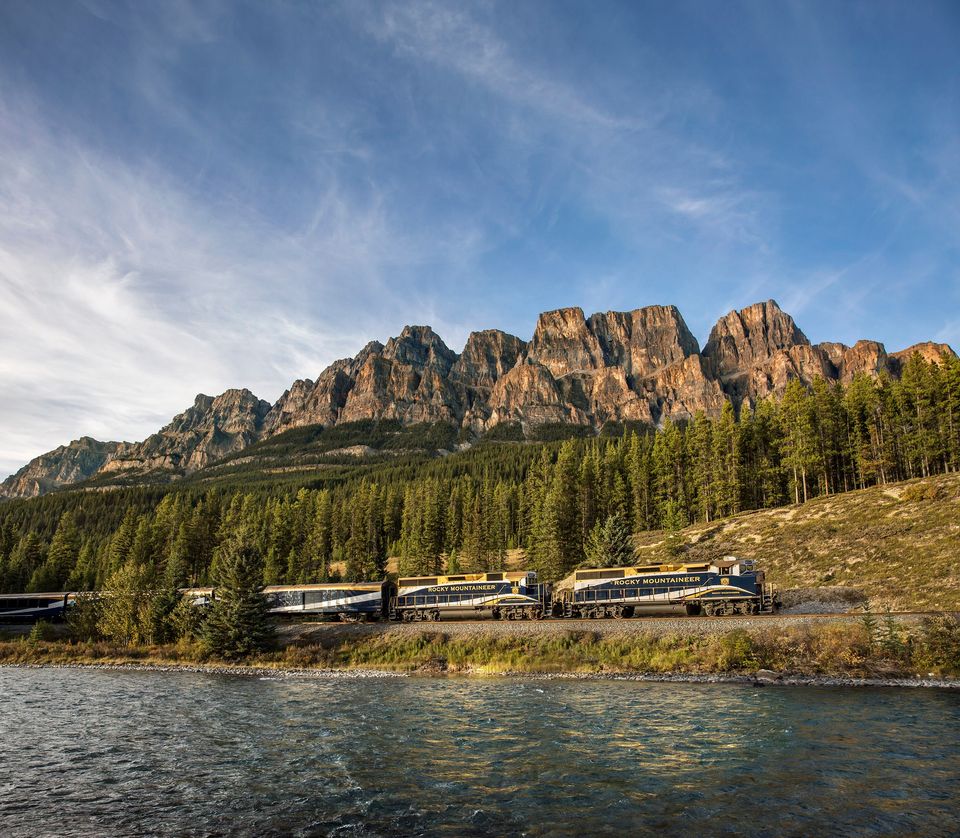
I was aboard the Rocky Mountaineer’s inaugural Rockies to the Red Rocks route, traveling from Denver to the outdoor playground of Moab, Utah. The Canada-based Rocky Mountaineer train company, which has been around for more than three decades, is known for multi-day rail journeys that snake through the Canadian Rockies, with stops in destinations like Whistler and Banff in carriages that are at least half glass. Inside, the experience involves tablecloths, cocktails, plush leather chairs, and expert hosts who narrate the voyage.
Dawn Ilsley
“The Canadian Rocky Mountaineer has been on our list of the world’s top 25 trains for decades,” says Eleanor Hardy, a Condé Nast Traveler top travel specialist and co-founder of the Society of International Railway Travelers, of the once-in-a-lifetime travel experience.
Bruce Schwierske
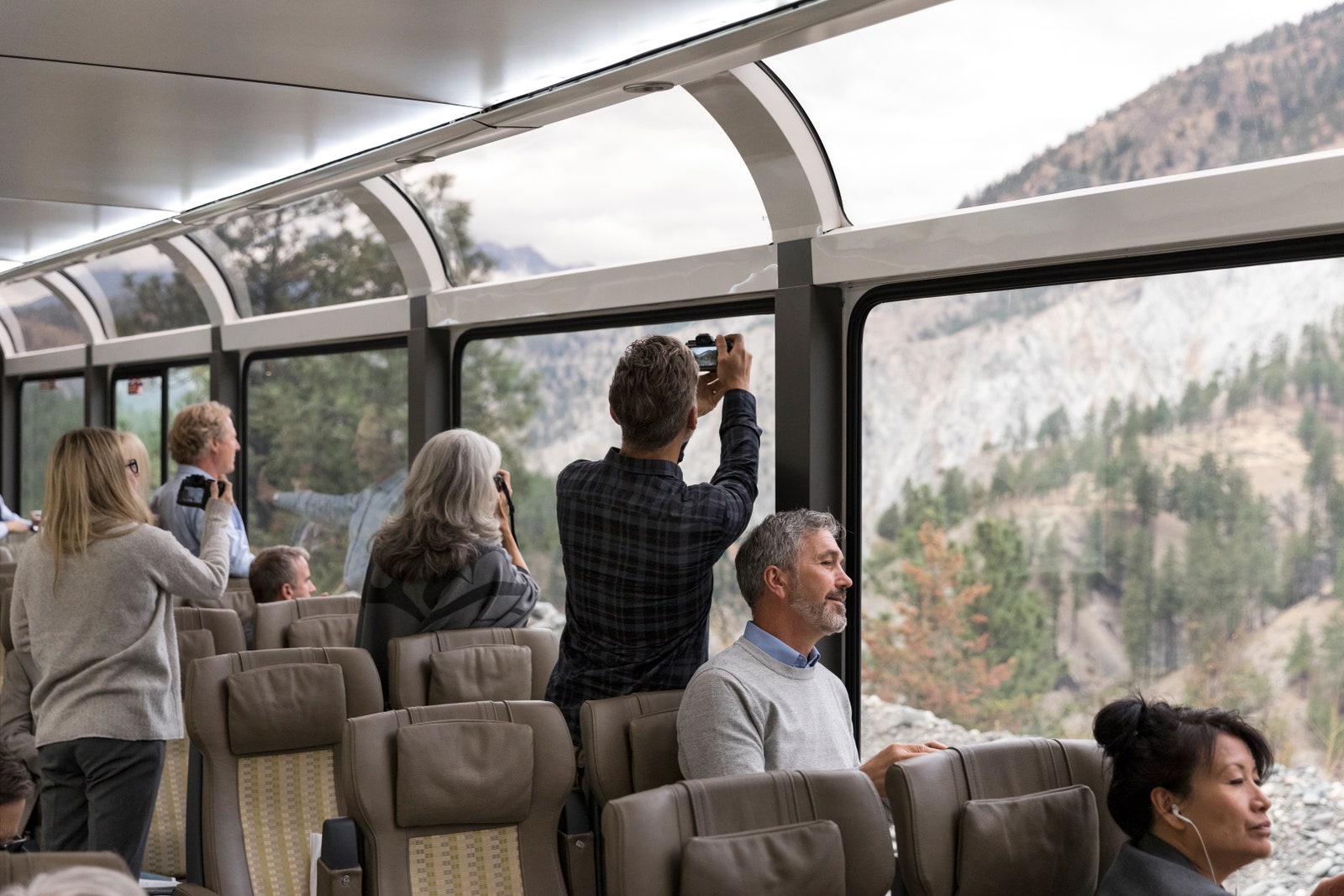
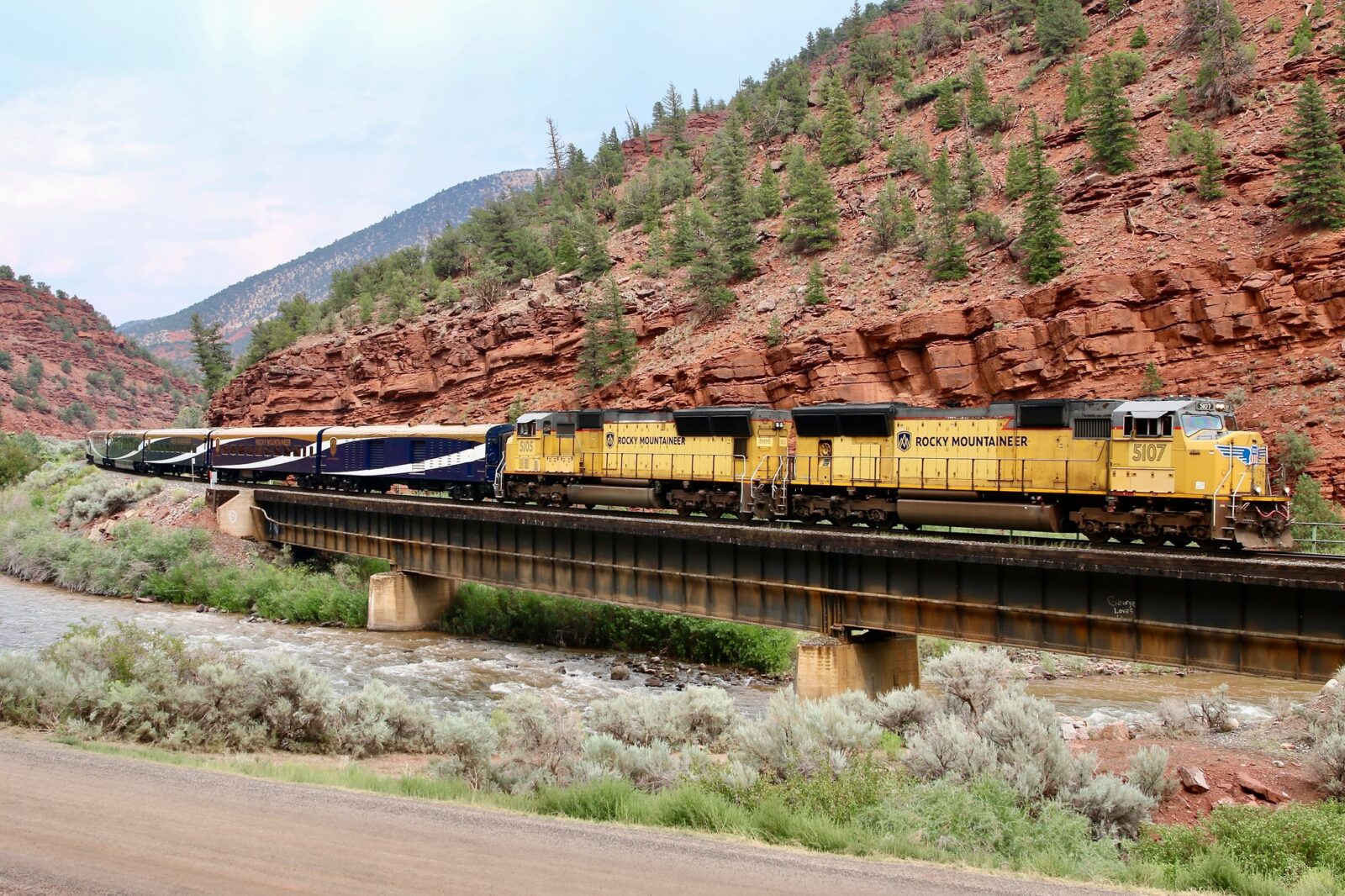
No wonder, then, that when the Rocky Mountaineer announced in December that it would launch this U.S. route in August, travelers were eager to hop on board. I joined 150 guests—plus more than 30 staffers, Rocky Mountaineer owner Peter Armstrong among them—for the inaugural journey. And for two days, all I did was stare out those windows, as we wiggled past pine-covered slopes, the rushing rapids of the Colorado River, and the otherworldly sandstone arches of Utah.
This is the brand’s entire ethos. “It’s about slowing down, and enjoying the journey—you really are unplugging and just along for that relaxing ride,” says Nicole Ford, director of communications for Rocky Mountaineer. To this end, Rocky Mountaineer trains travel only by daylight, at speeds of no higher than 40 miles per hour, and no, there’s no Wi-Fi on board.
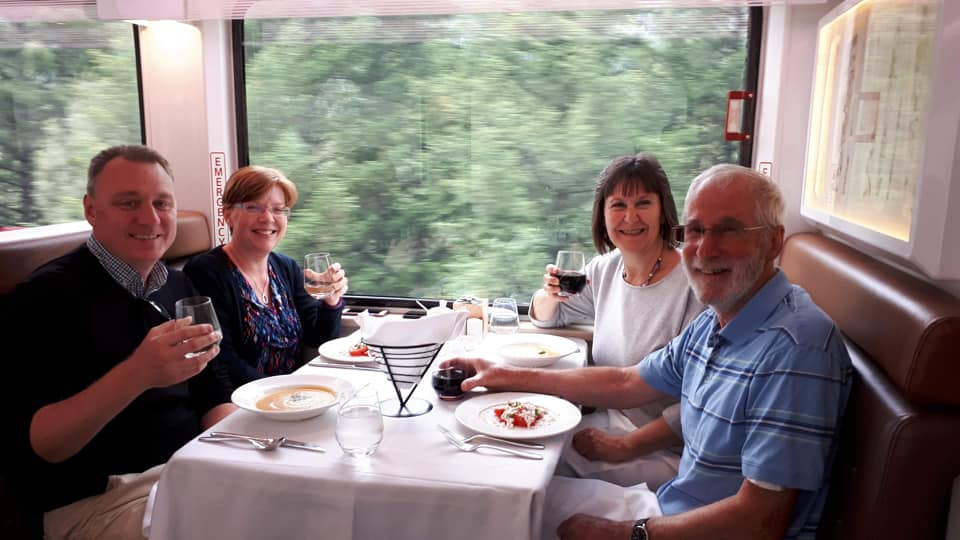
It’s fairly easy to sit still, as there’s plenty going on inside the train. A host stands at the front of each car and shares interesting facts, excitedly pointing out wildlife (we careened past no less than four bald eagles); a beverage cart wheels through regularly to refill wine glasses and lowballs. The clinks of silverware and the occasional toot of the train create a soothing soundscape. And the guests are an easygoing but chatty bunch: A troop largely made up of retired couples and multigenerational families, everyone gets to know their neighbors quickly. It’s easy to make friends, as I did with my seatmate. A 91-year-old veteran and former tour guide from Nashville, John was traveling by himself to celebrate his upcoming birthday. I, a few decades below and all too-willing to join him for a Bailey’s and coffee in the lounge car, probably wasn’t what he was expecting either.
“I’ve been describing it to people as a cruise on rails,” says Liz Birdsall of the Colorado Tourism Office. You can do as much or little as you’d like, everything comes to you, and the crowd is looking to see nice things and learn a bit, without scrambling to plan excursions themselves nor sacrifice comfort.
Comfort is key in the Rocky Mountaineer train experience. Each seat has plenty of legroom (think first class on a flight), and the pleather chairs recline by sliding forward to protect that leg space. But there are some key differences between this U.S. route and the Canadian offerings when it comes to the cars. In Canada, the brand offers a Gold Leaf service and a Silver Leaf service. Gold Leaf is the premium offering—ultimately, that’s the experience compared to iconic luxury journeys like the Orient Express—with two-decker cars that include 360 degree views thanks to glass-dome ceilings and walls, with a dining car on the first floor where hot meals (“a fabulous feast,” Hardy prefers to call them) are cooked and served on linen-covered tables. There’s also an open-air viewing deck that guests love.
Some luxury travel specialists, like Hardy, only sell Gold Leaf to their clients. Silver Leaf, on the other hand, has more of a traditional train set-up, with assigned seats and refined touches that set it a cut above an Amtrak experience. The Gold Leaf cars don’t fit through the Colorado tunnels, so the U.S. route includes a new category, dubbed Silver Leaf Plus: essentially, the Silver Leaf cars, with a few add-ons.
The Silver Leaf cars don’t have domed ceilings, but do have massive, yawning windows. There’s no kitchen in these cars, so the food is more or less akin to first-class airline food, with high quality ingredients like Coho salmon and pork loin (every menu is inspired by the train’s route), in dishes that have been cooked beforehand and warmed. Given those constraints, most guests around me were pleased with their meals. Unlimited drinks—mixed cocktails, beer, wine, soda—are part of the experience, with premium beverages part of Silver Leaf Plus. Though there is no dining car, and most guests stay in their seat for the entirety of the journey, there is a lounge with a bar (and Scrabble); for fresh air, the option is the vestibule between the trains, which is actually quite a nice place to be.
It was there, leaning my head out into the dry mountain air, that I personally felt the pull—my “I get it now” moment for train travel. I met train enthusiasts out there, who were eagerly telling me about how historic this route was (some had even taken a private sleeper car, tacked onto an Amtrak train, from the East Coast to link up with the Rocky Mountaineer); I waved at people on the ground who had driven out to watch this first train roll by. It was also a great place to connect with the destination, without the glass between us, which is ultimately what makes the train so notable: The Rocky Mountaineer is an elevated way to travel between Denver and Moab, a journey usually only done by car or plane.
Departing from the city of Denver’s industrial Five Points neighborhood (the brand hopes to soon travel from the iconic Central Station downtown), the train covers 157 miles on day one, with an overnight off-train stay in the town of hot spring-boasting town of Glenwood Springs. (This night of accommodations is included with your train ticket.) Connecting these two destinations by car is possible, and it takes just about two hours—but you’d miss the chance to ride through 29 train tunnels carved into the Rockies, including the Moffat tunnel that goes through the Continental Divide. (On the Rocky Mountaineer, this journey stretches from about 8 a.m. to 5 p.m.)
The next leg of the trip is just over a half-day, covering 197 miles, as the train crosses the state border into Utah, before grumbling to a halt in the middle of the desert outside Arches National Park (a short drive from the town of Moab). Moab is notoriously hard to reach—and, for what it’s worth, locals seem to prefer it that way—with most travelers road-tripping in, or taking a connecting flight into the itty-bitty Canyonlands airport that can eat up the better part of a day. This is the clincher: In comfortable Rocky Mountaineer cars, travelers can now access the adventure hub of Moab like never before. (Here, you’re within driving distance of many of Utah’s best public lands, including Arches, Canyonlands, and Dead Horse State Park.)
There is one other train that careens on these same rails, which is the Amtrak California Zephyr. Of course, those tickets come at a different price point, with a different level of service. For travelers who love the idea of the Zephyr but don’t want to fight for a seat upon boarding, or wait for their turn in the observation car (whose windows are essentially the size of the at-your-seat windows in the Silver Leaf cars), Rocky Mountaineer fills a gap.
Onboard, Armstrong teased that this is only the first U.S. route, with likely more to come. “We think there’s potential for a few other routes, in California, the Southwest, the Pacific Northwest,” he said. He also said the brand is talking to their train manufacturer, Statler, about designing Gold Leaf cars for that fit on the Rockies to the Red Rocks route.
Hardy isn’t surprised: “Interest in rail travel is sky high,” she says. After my two days on board, I can see why—getting to sit back and watch scenery play like a film is a unique travel experience, and one that I can only imagine more Americans will crave as we explore more ground in our own backyard.
What to know before you go:
Cost: Trips can be booked directly through Rocky Mountaineer, or with the help of a travel specialist. The two-day rail journey, which includes an overnight stay in Glenwood Springs, costs $1,100 for the Silver Leaf level and $1,645 at the Silver Leaf Plus level (the latter includes premium beverages and lounge car access). Extended packages are also offered, from a three-night offering that includes hotels on both ends (from $1619 for Silver Leaf; from $2,014 for Silver Leaf Plus), to much longer week-long journeys that connect to destinations like Salt Lake City, Vegas, Bryce Canyon, and Lake Powell.
Tours: Rocky Mountaineer will plan your trip-end-to-end, from hotels in Denver to hiking tours in Moab. That process still has some kinks being worked out; intrepid travelers with specific expectations should consider planning their own tail ends of the journey. Otherwise, consider tapping a travel expert who can ensure you nab the exact destination experiences you want, with your activity level in mind (important given that Moab caters to a generally adventurous crowd).
Hotels: Denver has no shortage of great hotels, from the hip The Ramble Hotel to the reliable Four Seasons Denver downtown. In Moab, the Hoodoo Moab Curio Collection by Hilton is the best stay right in the midst of things, and the Sorrel River Ranch is a luxe resort on the banks of the Colorado, about a 25-minute drive from town. A one-night hotel stay in Glenwood Springs is included in your train ticket, with a choice between three hotels: The historic Hotel Colorado has seen better days (room renovations are supposedly underway), and Hot Springs Lodge and Hotel Denver are just fine. If you want nothing but the best, work with a travel specialist to arrange something of your own—the Little Nell Aspen, for example, is just a 40-minute drive from the train station.
Other tips: You can ride the train in either direction. Currently, the Denver to Moab route is better for early risers, with a 9 a.m. departure in Denver, and a 7 a.m. departure from Glenwood Springs. Going the other way, travelers depart Moab at 2 p.m., and depart Glenwood Springs at 9 a.m. Your bags are transported between the various hotels and train; pack a small day bag, like a carry-on, with a sweater (the air-conditioning is pumping), your camera, reading material, and anything else you will need access to during the ride each day. Binoculars will come in handy for wildlife enthusiasts.